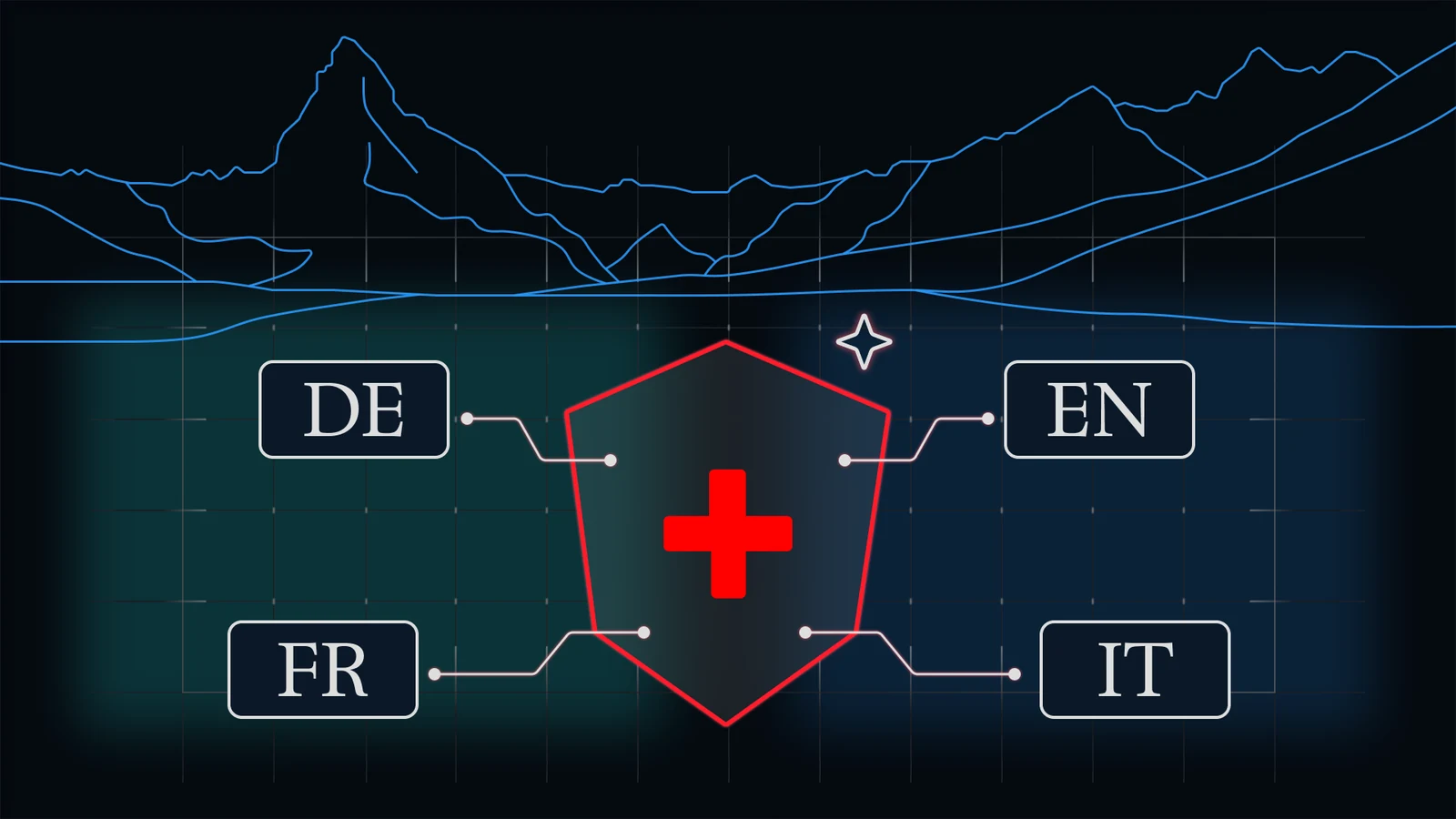
Switzerland has four national languages. This is not a folkloristic detail but a legal and business reality that any AI system must account for if it wants to be useful in Switzerland. An AI tool that only understands German is useless for a law firm in the Romandie. A system that only handles English misses Swiss legal terminology in all national languages.
Yet most AI providers treat multilingualism as a secondary feature. A German interface with a machine translation layer underneath. Or an English system that “also supports German.” That is not enough for Switzerland.
The Swiss Language Landscape in Numbers
The distribution of national languages in Switzerland is uneven. Around 63 percent of the population speaks German as their primary language, 23 percent French, 8 percent Italian, and just under 1 percent Romansh. English is not a national language but is used as a working language in many companies, especially in international contexts.
For companies operating across all of Switzerland, this means: your clients, mandates, and business partners communicate in at least three languages. Contracts are drafted in the language of the respective canton. Regulatory documents exist in all official languages. Court decisions are published in the language of the proceedings.
Why Translation Is Not Enough
The obvious approach of adding a translation layer to a monolingual AI system fails in practice due to three fundamental problems.
Technical Terminology Is Not Directly Translatable
Legal, financial, and technical terms carry distinct semantic nuances in each language. The German “Vertragserfüllung” is not identical to the French “exécution du contrat,” even though both terms describe the same matter. The subtle differences in usage, legal context, and connotation are lost in automatic translation.
In Swiss law, this problem is particularly acute because all three language versions of a federal statute are equally authoritative. There is no “original version” and no “translation.” When an AI system conducts legal research, it must treat all three versions as independent, authoritative sources, not as translations of one another.
Context Loss Through Translation
A user who asks a question in French expects an answer that considers the French-speaking legal context. If the system internally translates the question into German, searches German sources, and translates the answer back into French, context is lost. The answer may reference the German version of a statute when the user needs the French one. Or it may use terminology common in German-speaking Swiss practice but applied differently in the Romandie.
Quality Loss Through Double Processing
Every translation step introduces errors. When a system translates the input, then processes it, then translates the output back, these errors accumulate. The result is an answer that may be technically correct but reads unnaturally and is imprecise in its subject matter.
The Technical Challenge: Cross-Lingual Retrieval
For AI systems based on Retrieval-Augmented Generation (RAG), multilingualism presents a particularly demanding technical challenge. RAG systems work by first retrieving relevant documents from a database and then generating an answer based on those documents. The quality of the answer depends directly on how well the retrieval works.
The Embedding Problem
Most retrieval systems convert texts into numerical vectors (embeddings) and search for similar vectors. Monolingual embedding models place “Vertrag” and “contract” in entirely different regions of the vector space, even though they mean the same thing. Cross-lingual embedding models attempt to place semantically equivalent terms in different languages close together. The quality of these models has improved significantly in recent years, but they are still not perfect, especially for specialized terminology.
The Indexing Question
How do you organize a database that contains documents in multiple languages? There are several approaches, each with advantages and disadvantages.
Separate indexes per language. Each language has its own search index. This works well within a single language but fails for cross-lingual queries. If a user searches in German for a topic where the most relevant source exists in French, the system will not find it.
A shared multilingual index. All languages are combined in a single index using multilingual embeddings. This enables cross-lingual search but can reduce precision within a single language, because the model must make compromises between languages.
Hybrid approaches. A combination of language-specific and cross-lingual indexes, weighted differently depending on the query. This is the most complex but also the most capable approach.
The Generation Question
Even if retrieval works perfectly, the AI system must generate the answer in the correct language and the appropriate style. Modern language models are fundamentally multilingual, but their performance varies considerably across languages. Most models were trained predominantly on English data and perform best in English. German, French, and Italian are supported with varying quality.
For Swiss applications, there is the additional factor that Swiss Standard German differs from German Standard German (no eszett, distinct vocabulary such as “parkieren” instead of “parken”), Swiss French has its own characteristics, and Swiss Italian partially diverges from standard Italian.
What a Truly Multilingual System Must Deliver
Based on the challenges described above, concrete requirements can be defined for an AI system designed for Switzerland.
Native language support. The system must process each national language natively, not through a translation layer. A question in French is processed in French, answered with French-language sources, and output in natural French.
Cross-lingual search. The system must find relevant sources regardless of their language. If the best answer to a German question lies in a French court decision, the system must find it and make it accessible to the user.
Language consistency. The answer must be written entirely in the user’s language. Source references may be cited in the original language, but explanations must be provided in the user’s language.
Terminological precision. Technical terms must be used correctly in each language. Not the closest translation, but the term established in the respective professional vocabulary.
Swiss language variants. The system must understand and produce Swiss Standard German. “ss” instead of “ß,” Swiss terminology, Swiss conventions.
The Data Foundation
Multilingual AI for Switzerland also requires a multilingual data foundation. For legal research, this means: federal statutes in all three official languages, cantonal laws in the respective cantonal language, Federal Supreme Court decisions in the language of the proceedings, cantonal court decisions in the local language.
The Enclava platform by Mont Virtua comprises 27,795 statutes and over 1.1 million court decisions in all official languages. The database is continuously updated and covers both federal and cantonal levels. The retrieval system was specifically developed for multilingual Swiss requirements, with hybrid search indexes that provide both language-specific precision and cross-lingual completeness.
Why This Matters for Companies
Multilingualism is not a nice-to-have for Swiss companies. It is a business requirement. A law firm in Zurich handling a case in Geneva needs French-language sources. A financial services provider with clients in all language regions must understand regulatory requirements in all languages. A fiduciary office serving clients from the Romandie and German-speaking Switzerland needs a tool that handles both languages equally well.
AI systems that do not meet this requirement are incomplete for the Swiss market. They may work for certain regions, but they cannot cover the breadth that Swiss companies need.
Four languages are not a luxury. They are a prerequisite.
If multilingualism is relevant for your company, contact us at [email protected] or visit our contact page.